Japan has an entire category of dining that involves no chairs, no reservations, and often no English. It's some of the best food in the country, and most tourists never try it because it looks intimidating from the outside. We're here to tell you that standing up while eating isn't just acceptable in Japan. Sometimes it's the only way to do it right. The standing bar culture, the yakitori alleys filled with smoke, the basement food halls that sprawl for what feels like miles — these are the places where Japan's real food culture lives, away from the Michelin stars and the tourist menus.
Standing Bars — Tachinomiya
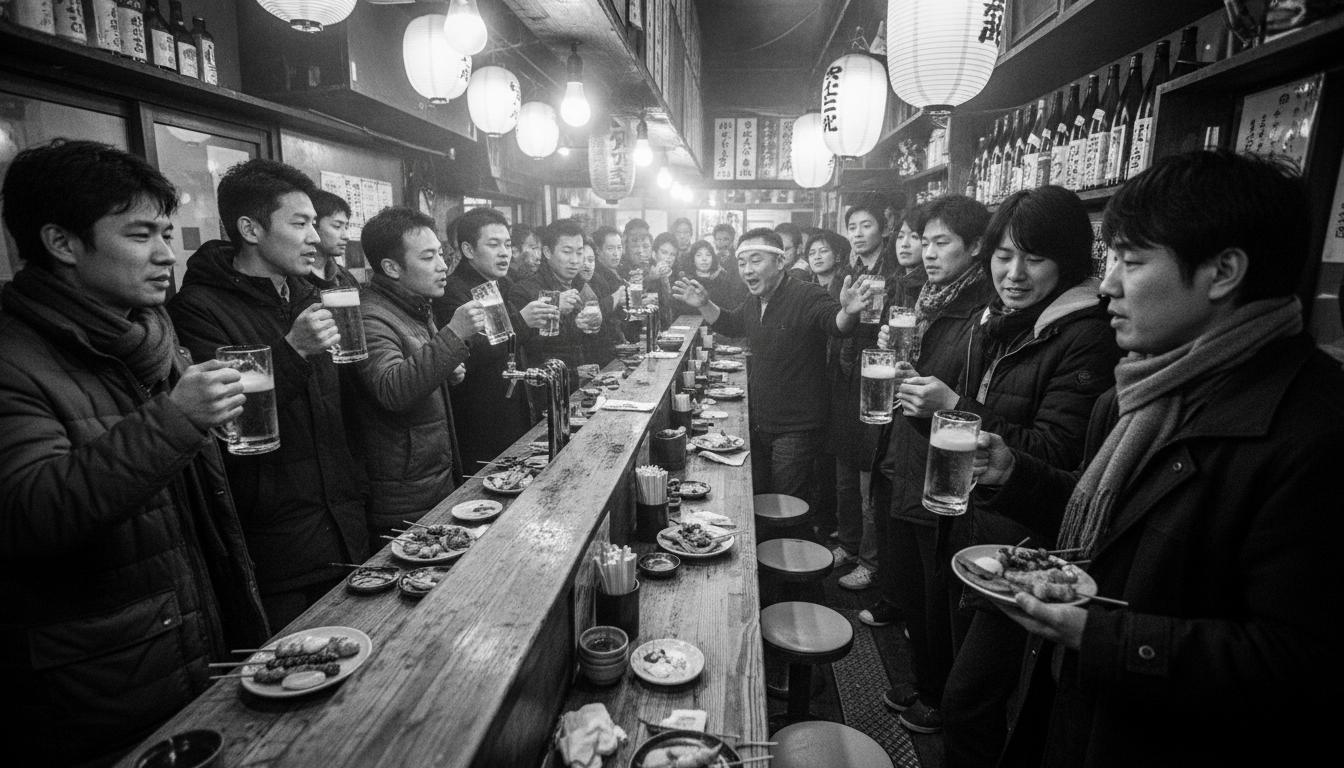
A tachinomiya in Tokyo. No seats, no cover, no problem.
Tachinomiya are Japan's answer to the pub, except there's nowhere to sit, the food is better, and you can be in and out in twenty minutes. These standing bars are everywhere in Tokyo and Osaka, often clustered near train stations where salarymen stop for a quick beer and a snack before heading home. They're one of the most egalitarian eating experiences in Japan. Everyone stands. Everyone pays the same prices. And everyone is there for the same reason: to unwind after a long day of work.
The setup is simple. A long counter, usually wooden and worn smooth by years of elbows. Behind it, a bartender or owner who might also be cooking. Above the counter, a menu written on paper signs or wooden boards. You stand, you order a drink and a few small plates, you eat, you pay, you leave. Or you order another round. That's up to you and your liver. We've seen people spend five minutes in a tachinomiya and we've seen people spend three hours. Both approaches are valid.
The food at tachinomiya is designed for drinking. Small plates of edamame, pickled vegetables, grilled meat on skewers, fried chicken, raw fish, and whatever else the owner feels like making that day. Portions are small and cheap, meant to be ordered in rounds as you drink. A typical tachinomiya meal might involve four or five plates shared among friends, plus several beers or highballs. The progression is natural: beer, food, more beer, more food, and eventually someone suggests karaoke or just going home.
Prices are refreshingly reasonable. A beer is usually 400 to 600 yen. Small plates range from 200 to 500 yen. There is no cover charge. There is no table charge. You pay for what you consume and nothing else. In a city where a single cocktail can cost 1,500 yen, tachinomiya are a revelation. We've had nights where we visited three different standing bars, ate ten different dishes, and spent less than 3,000 yen total. Try doing that in Ginza.
How to Order at a Tachinomiya
Walk in, find a spot at the counter, and catch the owner's eye. A simple "sumimasen" will get their attention. Pointing at the menu works if there's no English. Many tachinomiya have picture menus or display cases showing the food. If all else fails, say "osusume" and the owner will recommend something. Trust them. They know what's good today. We've never been steered wrong by asking for recommendations. The worst thing that happens is you try something new and don't love it, and you're only out 300 yen.
Pay as you go or pay at the end, depending on the place. Most tachinomiya are pay-at-the-end, but some require you to pay per round. Watch what the locals do. If they're handing over money after each order, do the same. If they're running a tab, you'll settle up when you leave. There's no universal rule, and nobody will be upset if you ask. A simple "okaikei onegaishimasu" when you want the bill works everywhere.
Yakitori Alleys — Smoke, Beer, Grilled Bits on Sticks
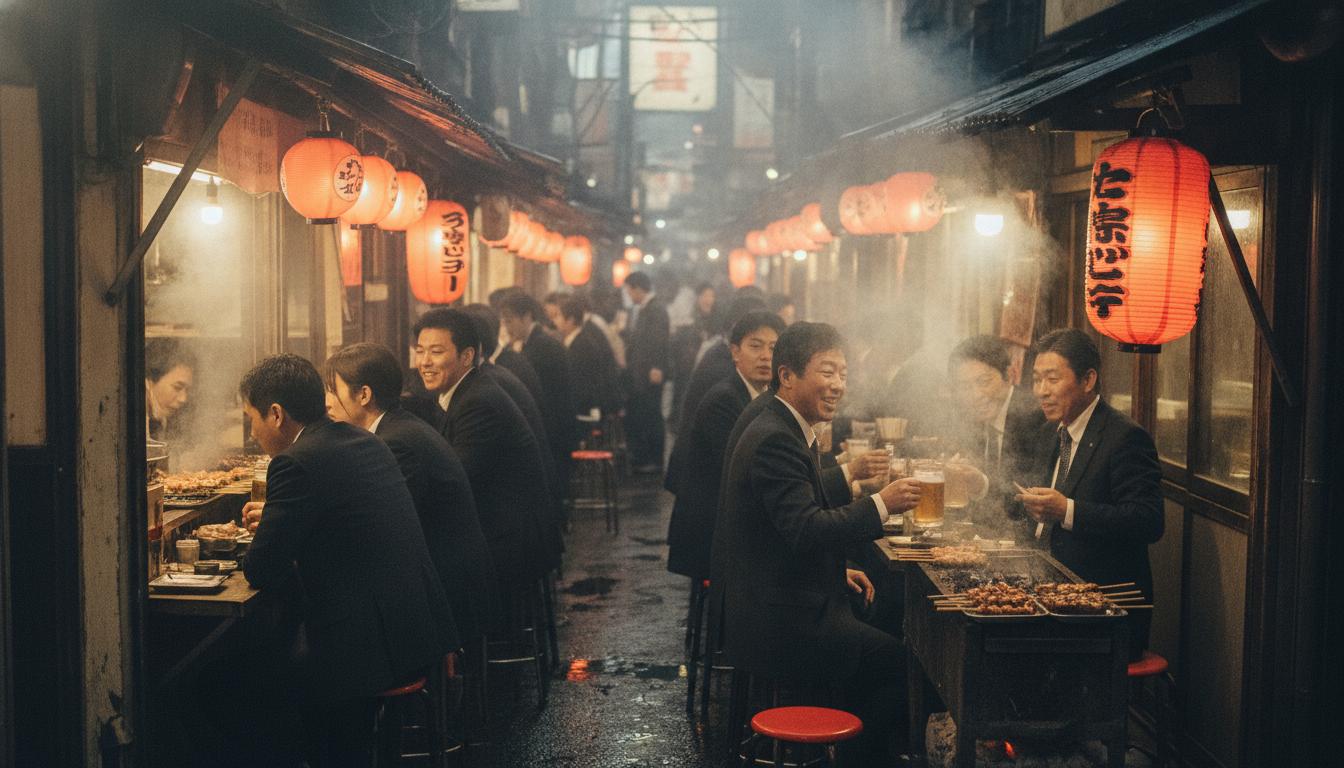
Omoide Yokocho. The smoke is part of the seasoning.
Yakitori alleys are what happen when a bunch of tiny grilled-chicken stalls decide to cluster together in a narrow passageway and share the smoke. The most famous is Omoide Yokocho in Shinjuku, also known as Memory Lane or Piss Alley, depending on who's translating. It's a narrow lane of maybe twenty tiny restaurants, most of them seating fewer than ten people, all of them grilling meat on sticks over charcoal. The smoke hangs in the air like a fog, the red lanterns glow through it, and the smell will make you hungry even if you just ate.
The best yakitori places have no seats and the owner is always slightly angry. That's how you know it's good. The angrier the owner, the better the chicken. It's an unwritten rule that has never failed us. These are specialists who have been grilling the same skewers for decades. They don't need your approval, but they'll notice if you appreciate the work. We've been to places where the owner warmed up significantly after our third round of orders, eventually recommending off-menu items that weren't available to first-timers.
Yakitori means "grilled bird" but covers a wide range of chicken parts. Breast, thigh, wing, skin, liver, heart, cartilage, and other bits that don't translate well. Each skewer is seasoned with either salt or tare, a sweet-savory soy-based sauce. The salt lets the meat speak for itself. The tare is richer and more complex. We order both and alternate. Our recommendation: start with momo (thigh) and negima (thigh with green onion), then get adventurous. The liver is creamier than you'd expect. The heart has a satisfying crunch. The skin is crispy and fatty and completely indulgent.
Prices are reasonable if you stick to the basics. Simple skewers start around 150 yen. Premium cuts and special items cost more. A filling meal of assorted skewers, a few vegetable items, and several beers will run 3,000 to 5,000 yen per person. Not cheap, but worth every yen. We've paid more for worse meals at sit-down restaurants. There's something about eating in a narrow alley, shoulder to shoulder with strangers, watching your food being grilled three feet away, that makes everything taste better.
Beyond Omoide Yokocho, Tokyo has yakitori alleys and clusters in Harmonica Yokocho in Koenji, Nonbei Yokocho in Shibuya, and scattered throughout Ebisu and Meguro. Osaka has its own version in the area around Dotonbori, though it's less concentrated. Fukuoka's yatai stalls serve a similar function, with ramen and oden alongside the grilled items. Every major Japanese city has these clusters of small, smoky, grilled-meat places, and finding them is one of the great pleasures of traveling here.
Conveyor Belt Sushi — When It's Okay, When to Avoid
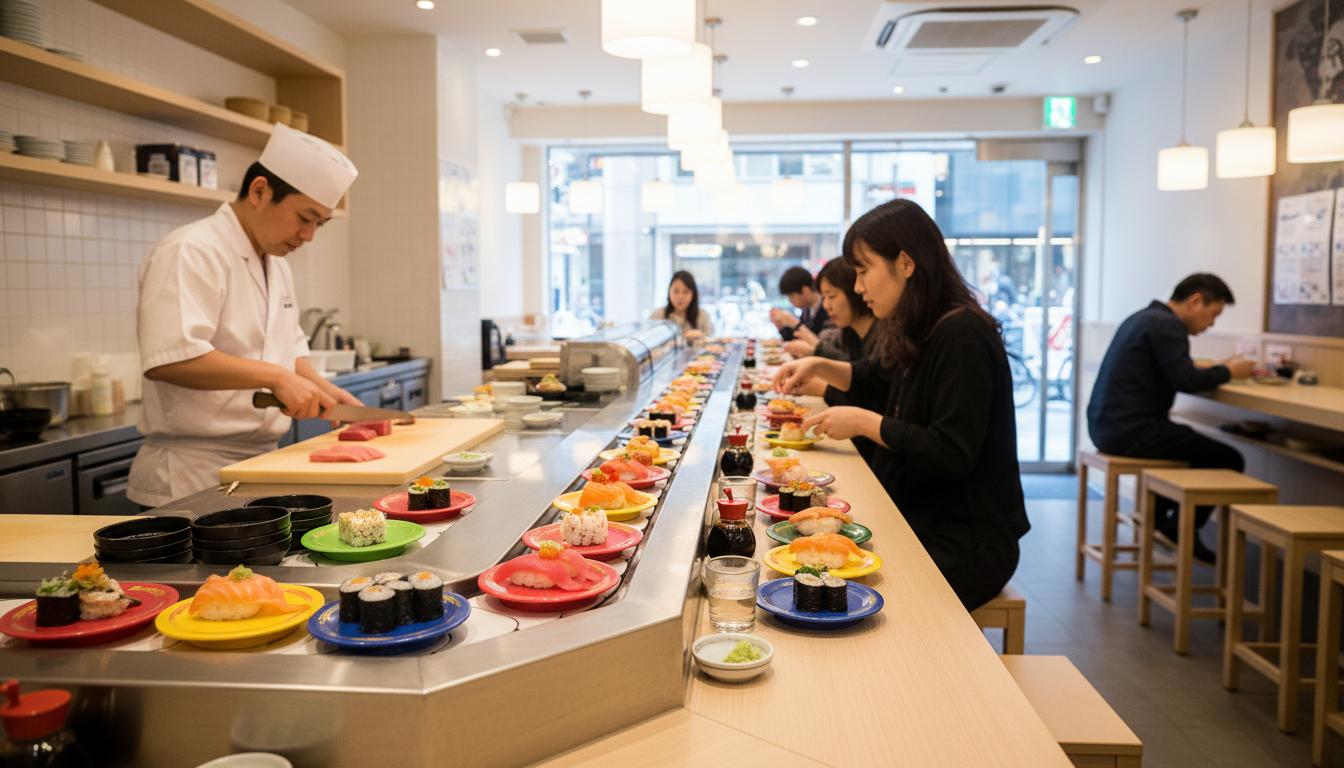
Conveyor belt sushi. Fast, fun, and sometimes surprisingly good.
Conveyor belt sushi, or kaitenzushi, gets a bad rap from food snobs who insist that all sushi must be eaten at a 300-year-old counter with a chef who trained for twenty years. Those people are missing out. Yes, high-end sushi is an experience worth having. But conveyor belt sushi serves a different purpose, and when done well, it's genuinely good. It's the fast food of Japanese cuisine, except the quality is consistently decent and the experience is genuinely fun.
The major chains like Sushiro, Kura Sushi, and Hamazushi have hundreds of locations across Japan. They're cheap, they're fast, and the quality is surprisingly decent for the price. Plates start at 110 to 150 yen for basic nigiri. A full meal costs around 1,500 to 2,500 yen. You order on a tablet, the sushi comes to you on a conveyor belt or a dedicated lane, and you stack your empty plates for counting at the end. Some locations have gamified the experience with plate-dropping mechanisms and prize systems that are more entertaining than they should be.
Our advice: go to the chains for a quick lunch or when you're traveling on a budget. They're clean, consistent, and the variety is impressive. Some locations even offer limited-edition items and seasonal specials that are genuinely creative. Avoid the conveyor belt places in major tourist areas like Asakusa or Shibuya Crossing, where quality drops and prices rise. The neighborhood locations are always better. The one in our neighborhood in Koenji knows us by sight now, which is either impressive or embarrassing depending on how you look at it.
For a step up, look for mid-range kaitenzushi like Katsumidori in Tokyo, which offers fish quality closer to a proper sushi restaurant while keeping the conveyor belt format. These places cost a bit more but deliver significantly better fish. It's a good middle ground between the 100-yen chains and the 10,000-yen omakase experience. We take visitors here when they want "real sushi" but don't want to spend a hundred dollars on lunch.
Depachika — Basement Food Halls
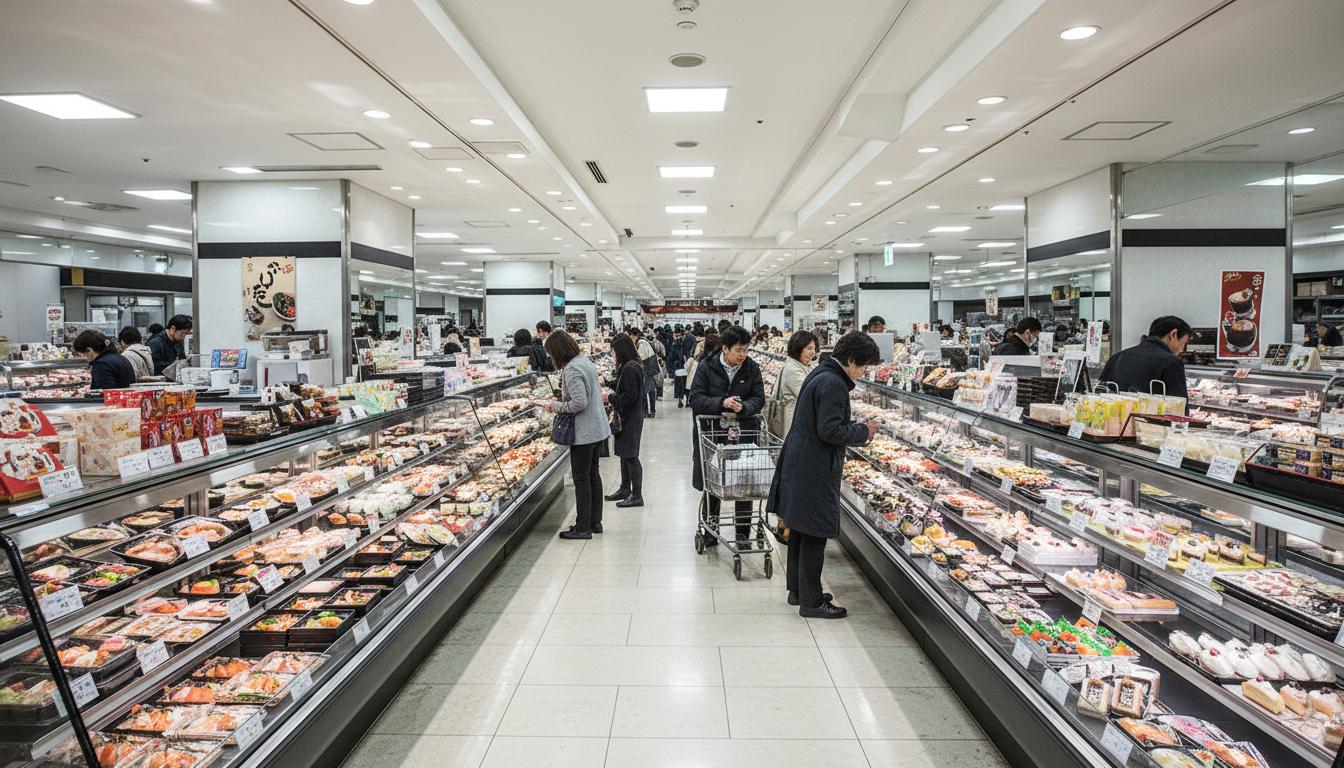
A depachika. Bring your credit card and your self-control.
Depachika are the underground food halls in Japanese department stores, and they are a miracle of human organization and culinary obsession. Walk down the stairs into a Takashimaya or Isetan basement and you'll find yourself in a maze of glass display cases containing more types of food than you knew existed. Sushi, tempura, bento boxes, French pastries, Japanese sweets, imported cheeses, fresh fruit that costs more than your lunch, and free samples everywhere. It's overwhelming in the best possible way.
The quality at depachika is uniformly high. These aren't mall food courts. They're curated collections of the best food vendors in the city, each operating a small counter in a shared space. Many of the vendors are famous restaurants that run their depachika counter as a secondary location. You can eat incredibly well without ever sitting down. We've had meals from depachika that rivaled proper restaurants. The tempura is fried fresh throughout the day. The sushi is made by chefs who trained at reputable restaurants. The pastries come from bakeries that have queues out the door at their standalone locations.
The best time to visit is around 7pm, when department stores start marking down unsold items. That 1,500 yen bento becomes 1,000 yen. The 800 yen tempura bowl drops to 500 yen. Locals know this, and you'll see a rush of office workers stopping by on their way home. It's competitive. Be polite but decisive. Hesitate and someone else will grab the last salmon bento. We've learned this the hard way. Mei once reached for a discounted sashimi set and an old woman literally moved her hand out of the way. Respect the discount rush. It's serious business.
Free samples are a depachika tradition. Vendors offer small bites of their products, and it's completely acceptable to sample before buying. We have made entire meals out of strategically timed depachika visits. Just remember that the samples are meant to lead to purchases. Don't abuse the system. And don't block the aisle while eating. Japanese depachika shoppers move with surprising speed and efficiency, and standing in the middle of the aisle eating a free piece of wagashi will earn you some very pointed looks.
Convenience Store Food — Actually Good
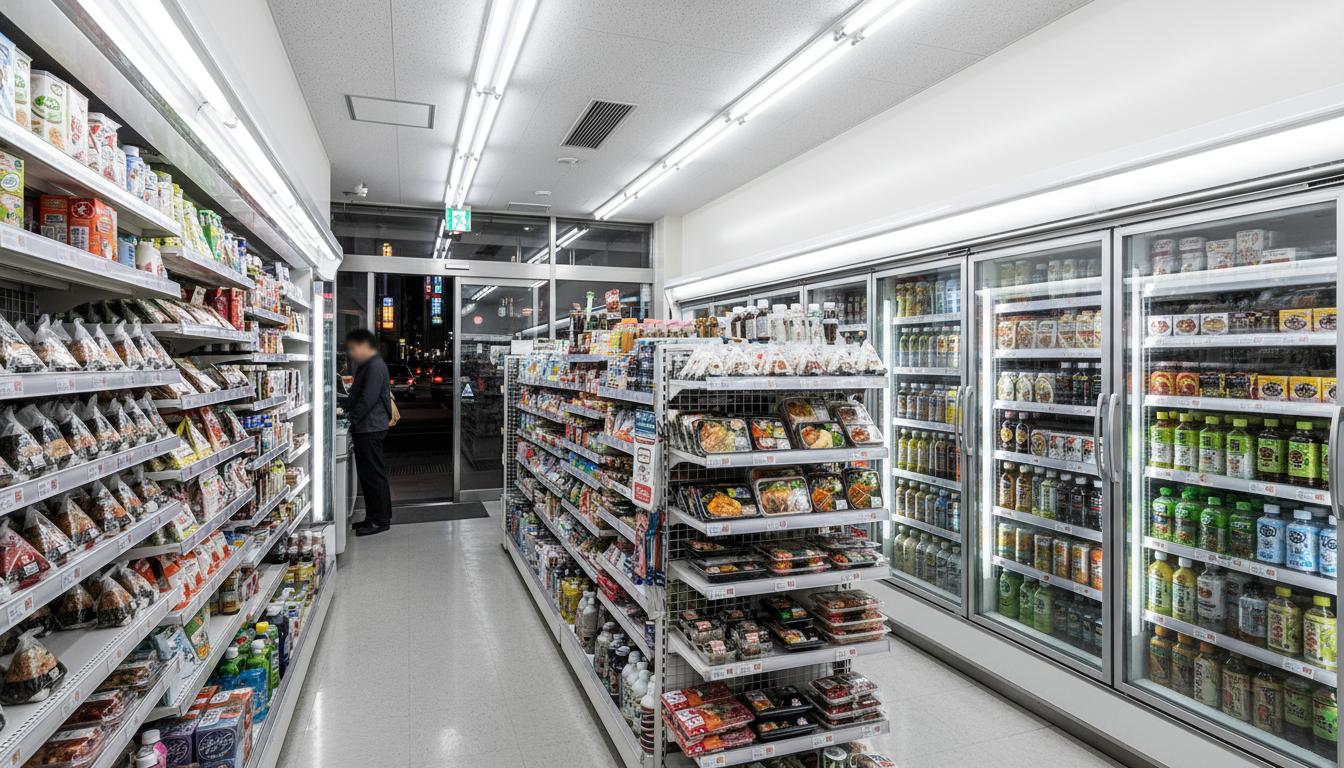
The konbini. Your 24-hour safety net for good, cheap food.
Japanese convenience stores, known as konbini, have a food selection that puts most countries' restaurants to shame. Onigiri rice balls with various fillings. Fresh sandwiches on pillowy soft bread. Pasta salads. Fried chicken that's genuinely crispy and flavorful. Bento boxes that change with the seasons. And everything is replaced daily, so nothing sits on the shelf for long. We've had konbini dinners that were better than meals at proper restaurants in other countries. It's not fine dining. It's fine eating, and there's a difference.
The three major chains each have their strengths. 7-Eleven has the best overall selection and the highest food quality standards. Their nigiri sushi is surprisingly decent, and their fried chicken is consistently good. Lawson has excellent fried chicken, known as Karaage-kun, and their premium line of desserts is dangerous if you have a sweet tooth. The matcha tiramisu is a particular threat to our self-control. FamilyMart has the best sandwiches, period. Their egg salad sandwich is a work of art that has inspired internet devotion and copycat recipes worldwide. It sounds absurd to rave about a convenience store sandwich, but you've never had this sandwich.
Konbini are also where you pay bills, buy concert tickets, send packages, use the bathroom, and take shelter from rain. They're the infrastructure of Japanese daily life, and the food is just one part of it. But what food it is. We've had konbini dinners that were better than meals at proper restaurants in other countries. It's not fine dining. It's fine eating. And at 2am, when everything else is closed and you just want something warm and comforting, the konbini is there for you. No judgment. Just a hot chicken steamer and a can of Highball.
The Rules of Eating in Japan
No Walking While Eating
This is less of a hard rule and more of a strong cultural preference, but it's worth knowing. In Japan, eating while walking is generally considered impolite. You buy your food, you stand near the vendor or find a place to sit, and you eat there. Then you move on. This is why you'll see people standing in clusters near popular street food spots, all eating silently and efficiently. It's not antisocial. It's considerate. Nobody wants to walk behind someone who's dripping sauce on the sidewalk.
The exception is festivals and events, where street food is designed to be eaten while strolling. And tourist areas are increasingly tolerant of foreign visitors who haven't learned the custom yet. But if you want to blend in, find a spot, eat your food, and dispose of your trash properly. Which brings us to the next point.
Oshibori
That hot or cold towel you get at every restaurant in Japan? It's called oshibori, and it's for wiping your hands before eating. Not your face, not your neck, not your table. Your hands. Use it, fold it neatly, and place it beside your plate when you're done. It's a small ritual, but it's part of the dining experience. Don't use it to clean your phone. Don't blow your nose in it. We've seen both of these things happen, and the embarrassment radiated through the entire restaurant.
Cash Is King
Despite Japan's reputation for technological advancement, cash remains the primary payment method at most restaurants, especially the small, independent places that serve the best food. Many tachinomiya and yakitori stalls are cash-only. Depachika usually take cards. Konbini take cards. But always carry cash, and carry more than you think you need. Running out of cash in a neighborhood with no ATM and a great-smelling yakitori stall is a special kind of torture that we've experienced more than once. Learn from our mistakes.
Ordering Without English
Many of the best places have no English menu. This is not a problem. Point at what someone else is eating. Point at the plastic food display in the window. Point at the menu board and hope for the best. Use Google Translate's camera feature to read menus. Or just say "osusume" and let the owner choose. Some of our best meals came from saying "surprise me" and accepting whatever arrived. The worst meal we ever got this way was still pretty good. That's the thing about Japan. The baseline quality is so high that even a random choice is usually decent.
Harmonica Yokocho — A Case Study in Cheap Eating
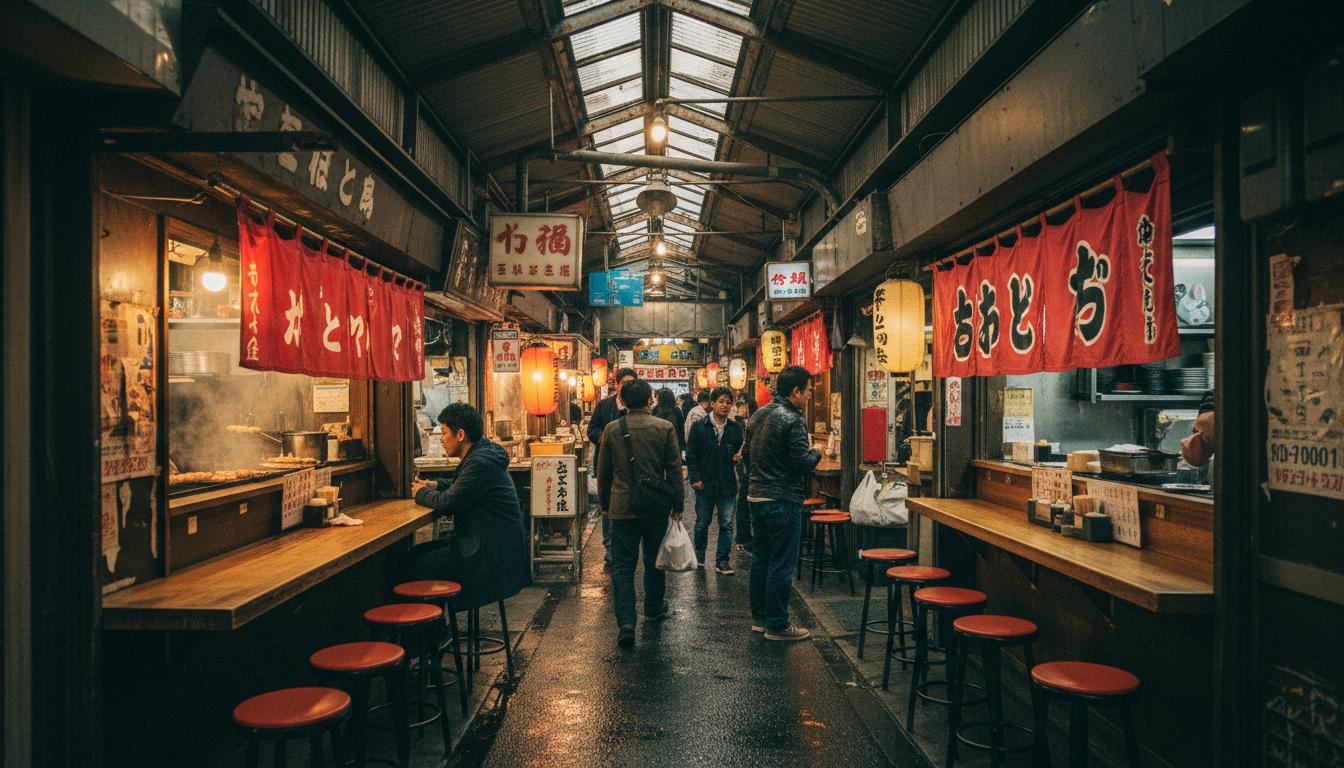
Harmonica Yokocho. Where 3,000 yen buys you a full night of eating and drinking.
If you want to understand Japanese street food culture in one location, go to Harmonica Yokocho in Koenji. This dense cluster of tiny stalls and bars, located just north of Koenji station, contains everything that makes Japanese cheap eating great. grilled meat on sticks, cold beer, no seating, no pretension, and prices that haven't changed much since the 1990s. You can eat and drink your way through an entire evening here for under 3,000 yen, and you'll leave with a full stomach and probably a new friend or two.
The stalls specialize in different things. Some do yakitori exclusively. Some do grilled seafood. One famous stall does nothing but kushikatsu, deep-fried skewers of meat and vegetables that you dip in a communal sauce pot exactly once. Double-dipping is not just rude here. It's a violation of the social contract. The owner will call you out on it, and the other customers will stare. Don't double-dip. We can't stress this enough.
What makes Harmonica Yokocho special is the atmosphere. The stalls are packed into a space the size of a small parking lot. Smoke rises from multiple grills. Beer flows steadily. Conversations happen between strangers because there's literally nowhere else to look. We've had some of our best Tokyo nights here, talking to locals who stumbled in after work and decided to stay for three hours. The language barrier is real but surmountable. Pointing, smiling, and saying "kanpai" before drinking covers most situations.
Depachika Etiquette — How to Not Look Lost
Department store food halls have their own unwritten rules, and understanding them makes the experience much better. First, don't touch the food with your hands. Everything is behind glass for a reason. Point to what you want and a staff member will get it for you. Second, don't take photos of individual items without asking. Some vendors don't mind, but others consider it intrusive. Third, be mindful of the line. At popular counters, especially around noon and 6pm, there can be queues. Don't block the aisle while deciding what to order.
The best strategy for depachika shopping is to circle the entire hall before buying anything. This lets you see all the options and prevents the regret of buying a bento only to discover a better one three counters later. Take note of which vendors have lines. A long line usually means high quality or good value. During discount time around 7pm, move quickly and decisively. The good stuff goes fast. We've seen a perfectly good tempura set disappear from the counter while we were still deciding whether to buy it. Someone else made that decision for us.
Final Thoughts on Japanese Street Food
The truth about eating in Japan is that there are very few truly bad meals. The standards are high everywhere, from the cheapest konbini to the most expensive kaiseki restaurant. If a place has been in business for more than a few years, the food is probably good. Trust your instincts, trust the locals, and don't overthink it. The best food experiences in Japan are often the ones you didn't plan. The random bar you ducked into to escape the rain. The train station bento you bought because you were hungry and it looked good. The konbini sandwich at midnight that changed your understanding of what a sandwich could be. That's the Japan we write about.
Sushi — From Conveyor Belts to Tiny Counters
We can't write about Japanese street food without mentioning sushi, even though most tourists don't think of sushi as street food. Conveyor belt sushi, which we covered earlier, is the entry point. But there's a whole spectrum of sushi experiences between the 100-yen chains and the 30,000-yen omakase temples. The mid-range places, where lunch costs 2,000 to 5,000 yen, often deliver the best value. The fish is excellent, the rice is properly seasoned, and you don't need a reservation made three months in advance.
Standing sushi bars exist in Tokyo and they're one of the best deals in the city. You stand at a counter, order piece by piece, and eat quickly. The fish is cut fresh in front of you. The prices are reasonable because there's no seating, no service, and no atmosphere to speak of. Just fish, rice, and soy sauce. We've had outstanding tuna and salmon at standing sushi bars near Tsukiji for under 2,000 yen. The experience is over in twenty minutes, but the memory lasts longer.
For a step up, look for lunch specials at proper sushi restaurants. Many high-end places offer significantly cheaper lunch menus to fill seats during the day. You might get eight pieces of nigiri and a roll for 3,000 yen at a place where dinner costs 15,000 yen. The fish quality is the same. The only difference is the time of day and the number of courses. Lunch sushi is one of Tokyo's best-kept secrets, and we're slightly reluctant to share it because we don't want our favorite places to get too crowded.
Final Thoughts on Japanese Street Food
Japan rewards the curious eater. The person who's willing to point at something they can't identify and say "kore, onegaishimasu" will have better meals than the person who insists on English menus and familiar ingredients. Take the risk. Eat the thing. If it's weird, it's a story. If it's great, it's a memory. Either way, you win.
Drinking in Japan — Beer, Highballs, and Sake
We can't talk about Japanese street food without talking about what you drink with it. Beer is the default companion to almost every casual meal in Japan. The major domestic brands — Asahi, Kirin, Sapporo, Suntory — are all light, crisp lagers that pair perfectly with grilled meat and fried things. They're not trying to be craft beer. They're trying to be cold and refreshing, and they succeed. A draft beer at a tachinomiya costs 400 to 600 yen and arrives so cold that the glass sweats immediately.
Highballs are Japan's other great drinking invention. Whiskey and soda water, served in a tall glass with lots of ice. Simple, cheap, and dangerously drinkable. Every convenience store sells canned highballs for around 150 yen, and most bars make them fresh for 400 to 500 yen. The highball is the unofficial drink of the Japanese salaryman, and it's become our unofficial drink too. When in Rome, drink what the Romans drink. When in Tokyo, drink highballs.
Sake is more complex and deserves its own guide, which we haven't written yet. For now, know that sake at an izakaya is usually served warm in a small ceramic flask called a tokkuri, and you pour it into tiny cups called ochoko. The quality varies dramatically. Cheap house sake is drinkable but unremarkable. Premium sake can be transcendent. If you're curious, ask the owner for a recommendation. They'll usually suggest something in the middle price range that represents good value. Don't be intimidated by the sake ritual. It's just rice wine, and the owner wants you to enjoy it. Start with a small flask and see how you feel. You can always order more.
Final Thoughts on Japanese Street Food
The best advice we can give about eating in Japan is to not overthink it. Don't spend hours reading reviews. Don't obsess over finding the "best" ramen shop. Don't worry about whether you're doing it right. There is no right way to eat. There is only your way, and Japan has enough good food that you'll find something you love even if you choose randomly. Trust us. We've been choosing randomly for years, and we've had maybe three bad meals. Out of thousands. Those are odds you can live with. Japan is a food lover's paradise, and even its mistakes are usually edible and sometimes surprisingly good if you're lucky and adventurous.
Breakfast in Japan
Breakfast in Japan is underrated by most travel guides. The typical Japanese breakfast of grilled fish, rice, miso soup, and pickles is available at most hotels and is a revelation if you've never had it. The combination of savory, salty, and umami flavors wakes you up better than any coffee. If your hotel doesn't offer Japanese breakfast, look for a kissaten coffee shop that serves morning sets. For around 500 yen, you get toast, a boiled egg, and coffee. It's simple, satisfying, and quintessentially Japanese.